
Tenant not paying rent: a step-by-step guide for landlords
Author: Sandra Jakulė, independent real estate broker in Vilnius since 2013
When a tenant is late paying for the first time, many landlords feel uncomfortable. Nobody wants to seem pushy. Perhaps the tenant simply forgot, or perhaps they are going through a difficult time. So a week passes, then another, until a late payment becomes a debt.
I understand that feeling. But over the years, I have learned that a calm, timely reminder does not damage a relationship. Often, an honest conversation is exactly what helps both sides find a workable solution.
I remember one case. My client's tenant began paying rent late: first by a few days, then increasingly longer. My client became worried and wanted him to leave. It turned out that he was a young person without a steady income.
After an honest conversation, we found a solution: his parents agreed to pay for the apartment every quarter. My client felt reassured, and the arrangement was more convenient for his parents too, as they no longer needed to make a bank transfer every month.
Not every story ends so well. Below, I explain what to do step by step, from the first late payment to a situation that requires legal help.
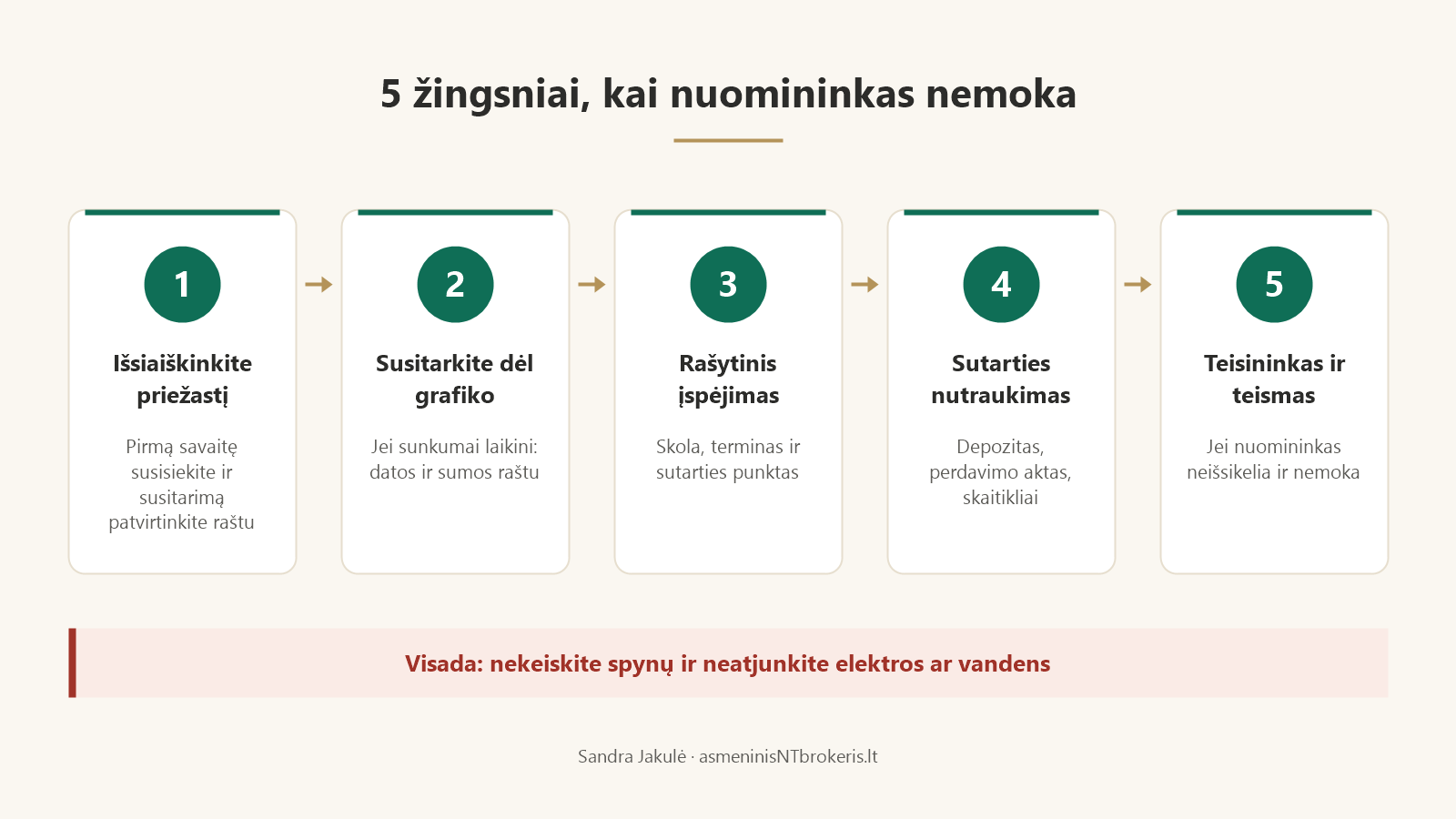
Sandra Jakulė's Lithuanian-language infographic: “Five steps when a tenant does not pay”. View the full-size infographic.
The five steps in English:
- Find out why the payment is late.
- If the difficulty is temporary, agree a repayment schedule in writing.
- If the agreement is not followed, send a written notice.
- Review the grounds for ending the tenancy and the final account with a lawyer.
- If the tenant refuses to leave, apply to court for compulsory eviction.
The diagram is a guide to the process. The legal grounds and procedure for each action must be assessed separately.
1. In the first week: call and listen
As soon as you notice that the money has not arrived, contact the tenant. Start by asking what happened rather than making accusations. Often, it is simply an oversight or a delayed salary, and the problem is resolved within a day.
After the conversation, send a short message: “As agreed, you will pay November's rent by the 15th.” This is sensible record-keeping, not a sign of distrust. If a disagreement arises later, written agreements will be part of your evidence.
2. If the tenant is struggling: look for a solution together
A tenant who has lost their job, become ill or does not yet have a steady income is not necessarily a bad tenant. You can agree a repayment schedule. Record the specific dates and amounts, and both confirm the agreement in writing, for example by email.
You can also discuss help from family members. However, parents paying the rent does not in itself amount to a guarantee. If you agree on a guarantee, it must be set out in a written agreement with a clearly defined scope of liability.
There is no need to lose a good tenant immediately: finding someone new, leaving the apartment empty and preparing it again all cost money. When assessing the overall return on your rental, you can use the profitability calculator.

3. If an agreement does not work: written notice
Sometimes a tenant breaks their promises or simply stops answering. It is then time for a formal but calm written notice.

Include:
- how much the tenant owes and the period it covers;
- the date by which the debt must be paid;
- the lawful action you will take if it remains unpaid, and the contractual and statutory provisions you rely on.
Send the notice using the method specified in the tenancy agreement, such as registered post or email. Keep evidence of sending it and, where required, of delivery.
4. Ending the tenancy and using the deposit
If you cannot reach an agreement, review the grounds and procedure for ending the tenancy with a lawyer. Where the grounds are persistent non-payment of residential rent or utility charges, Article 6.611 of Lithuania's Civil Code provides for a period of at least three months, unless the agreement specifies a longer one. This does not mean you must wait that long before sending reminders or demanding payment. The notice itself does not automatically end the tenancy, and a tenant who refuses to leave can be compulsorily evicted through the courts.
The deposit can be used towards a debt if there is a contractual and legal basis for doing so. Record in writing which debt it is being applied to and how much is being used, and provide a final account. Do not treat the deposit as automatic payment of the last month's rent.
When the tenant leaves, complete a handover record together: meter readings, the condition of the apartment and the keys returned. Photograph the rooms. This gives both sides peace of mind.
5. If the tenant refuses to leave: a lawyer and the courts
I understand that patience may be wearing thin by this stage. But this is also when the most mistakes are made. Do not change the locks, remove belongings or cut off electricity or water. Even if the tenant owes you money, such actions can work against you.
Contact a lawyer. You can ask the court to award the debt and order the tenant's eviction. If an enforceable court decision is not complied with voluntarily, the enforcement document can be submitted to a bailiff. The more written evidence you collected in the earlier steps, the more straightforward this process will be.
If you live in another city or abroad
Dealing with the situation from a distance can cause even more anxiety. Agree in advance who can represent you in Lithuania, inspect the apartment at a time agreed with the tenant, collect the keys and sign the handover record. Clearly define the representative's authority in the power of attorney and check what form is required for the intended actions. A power of attorney alone does not give someone the right to enter the property without lawful grounds or evict the tenant.
How to reduce the risk next time
Many of these situations can be anticipated before signing an agreement: get to know the tenant, take a deposit, put clear terms in writing and check payments every month. I discuss this further in my article on protecting yourself against tenants who do not pay (in Lithuanian).
In my experience, tenants are much less likely to pay late when they see that their landlord tracks payments and sends a reminder as soon as a deadline is missed.
My advice is simple: if the rent is a week late, send a message or call that very day. Recovering one month's unpaid rent is much easier than recovering six months' worth, and a conversation started in time often helps you keep a good tenant.
Frequently Asked Questions (FAQ)
Can I end the tenancy after one late payment?
One late payment does not mean that the tenancy can be ended automatically. Where the grounds are persistent non-payment of residential rent or utility charges, Civil Code Article 6.611 provides for a period of at least three months, unless the agreement specifies a longer one. Review the particular agreement and termination procedure with a lawyer, and send a reminder about the debt promptly.
Can I use the deposit to cover rent arrears?
The deposit can be applied towards a debt where there is a contractual and legal basis. Record which debt it covers and the amount applied, and provide a final account. The deposit does not in itself release the tenant from ongoing payment obligations.
Can I change the locks or disconnect the electricity?
Do not use these measures to force a tenant to pay or leave. If they refuse to leave voluntarily, apply to court for compulsory eviction. An enforceable decision is carried out by a bailiff.
Does rent paid by parents mean they have given a guarantee?
No. A payment alone is not a guarantee agreement. A guarantee requires a separate written agreement with a clearly defined scope of liability.
Sources:
- Lithuanian Civil Code Article 6.611: ending a tenancy following a tenant's breach — accessed 2026-11-03; INFOLEX displays the consolidation effective 2026-09-27. In Lithuanian.
- Lithuanian Civil Code Article 6.610: termination and eviction procedure — accessed 2026-11-03. In Lithuanian.
- Lithuanian Civil Code Article 6.79: form of a guarantee agreement — accessed 2026-11-03. In Lithuanian.
- Lithuanian Chamber of Bailiffs: when eviction from residential premises is possible — accessed 2026-11-03; explanation of the roles of courts and bailiffs. In Lithuanian.
- Sandra Jakulė: protecting yourself against tenants who do not pay — accessed 2026-11-03. In Lithuanian.